
The VA “Reduced Its Backlog.”
A claim that has been processed is not necessarily a claim that has been properly evaluated, fairly rated, or functionally resolved.

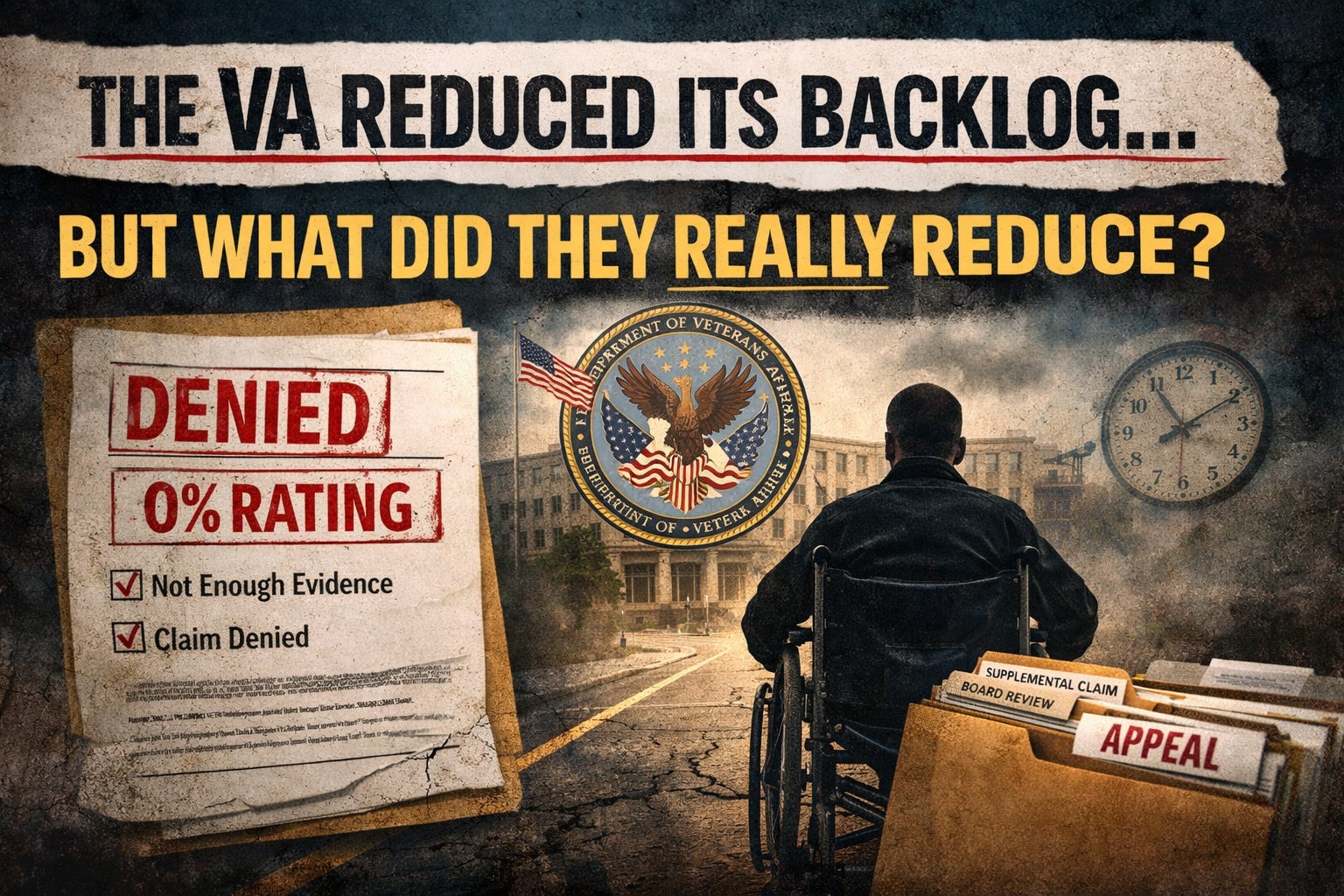
Recently, headlines — and official announcements — began circulating celebrating a major administrative milestone from the Department of Veterans Affairs.
According to VA reporting, more than 3 million disability compensation and pension claims were processed in 2025, while also reducing the number of claims pending longer than 125 days by over 60%.
In the announcement, the VA states that the disability benefits claims backlog has fallen below 100,000 cases for the first time since early 2020. The Department attributes this reduction to record levels of claims processing over the past year, increased staffing, expanded use of automation and digital tools, and targeted efforts to address claims pending longer than 125 days. Officials have described the milestone as a sign of improved efficiency and a step toward delivering faster decisions for veterans and their families.
The Department’s official press release announcing that the VA benefits claims backlog has dropped below 100,000 for the first time since 2020 can be found here:
The golden question is…
Did they reduce it by actually resolving claims?
Or by moving quickly enough to say:
“Denied.”
“0%.”
“Not enough evidence.”
“Condition does not meet compensable criteria.”
Because let’s be honest for a second:
If a system works through its pending files faster — but does so by issuing decisions that force veterans into the appeals process anyway — has the problem actually been solved?
Or just… relocated?
And to the average civilian — someone who has never interacted with the VA disability system — that sounds like meaningful progress.
Shorter wait times.
Faster decisions.
A shrinking backlog.
In most institutions, that would signal improvement.
But the VA disability claims process does not function like customer service.
It functions more like an insurance adjudication system — one tasked with determining:
Whether a medical condition exists
Whether it is connected to military service
And whether its severity meets legal criteria for compensation
All within a layered framework of medical exams, regulatory standards, and evidentiary thresholds.
Which means that in this system:
A claim that has been processed is not necessarily a claim that has been properly evaluated, fairly rated, or functionally resolved.
It simply means a decision was issued.
Compared to What?
Because without historical outcome comparisons, processing speed is only half the story.
If 2025 saw record claim processing volume, we should also be asking:
How does the denial rate in 2025 compare to 2024?
How many of those processed claims were granted at 0%?
How many were rated at 10% despite documented functional loss?
Has the rate of Higher-Level Review requests increased year over year?
Are more veterans filing Supplemental Claims within 12 months of an initial decision than in previous years?
Has the number of Board of Veterans’ Appeals remands changed since backlog reduction became a priority?
Because here’s the uncomfortable administrative reality:
A denial clears the backlog just as effectively as an approval.
A 0% rating reduces pending inventory just as efficiently as a 70% rating.
An incomplete exam that fails to capture flare-ups reduces the backlog.
A decision that results in an immediate appeal still counts as:
✔️ Processed
✔️ Closed
✔️ Removed from pending inventory
Even though the veteran’s case is far from over.
What Counts as “Processed” in the First Place?
The term itself is administratively broad.
A claim can be counted toward backlog reduction whether it results in:
A full grant of benefits
A partial grant
A 0% service-connected rating
A denial for lack of nexus
A denial for insufficient medical evidence
A denial for failure to attend an exam
Or a determination that symptoms do not meet compensable criteria
From a statistical standpoint, both outcomes are equally useful in shrinking the number of claims waiting for action — even though their real-world impact on the veteran could not be more different.
For example:
A veteran may have:
Undergone knee surgery
Required months of recovery using assistive devices
Returned to duty with a wheelchair, then a walker, then crutches
Experienced chronic swelling or mobility limitations
…and still receive a 0% or 10% rating if the examination snapshot does not capture:
Flare-ups
Instability
Fatigue after repetitive use
Pain during prolonged standing
Or functional loss during ordinary daily activity
This is not theoretical.
This is what I am navigating right now.
Which means that while my case may be counted as “processed” for administrative purposes…
my fight for an accurate evaluation is far from over.
When a Grant Still Leads to an Appeal
One of the least understood aspects of VA adjudication is that:
A claim can be technically approved…
and still require immediate appeal.
This happens when:
The condition is service-connected
But the assigned rating fails to reflect functional impairment
So the veteran must now choose between:
Higher-Level Review
Supplemental Claim with new evidence
Or Board of Veterans’ Appeals review
Each of which can extend the process by:
Months
or
Years
Meaning the administrative burden has not been eliminated.
It has been deferred downstream.
A Reduced Backlog — and a Rising Appeals Inventory?
If initial claims are being processed more quickly, but a growing percentage result in:
Denials
0% ratings
Minimal compensable evaluations
Or incomplete nexus determinations
…how many of those cases are simply being reintroduced into the system through appeal?
And if so:
Is the overall workload actually being reduced?
Or redistributed?
From:
Pending Initial Claims
to
Pending Supplemental Claims
to
Pending Higher-Level Reviews
to
Pending Board Appeals
In effect, the visible backlog may be shrinking — while the invisible appeals pipeline expands.
Metrics That Would Tell the Full Story
If policymakers and the public want to meaningfully evaluate system performance, the following data points would offer a more accurate picture than processing speed alone:
Initial claim denial rates
Percentage of grants at 0%
Percentage of ratings later increased on appeal
Average time from initial denial to final adjudication
Rate of Higher-Level Review corrections
Rate of Board remands due to inadequate exams
Frequency of duty-to-assist errors
Without these figures, it is difficult to determine whether faster processing reflects:
Improved adjudication quality
or
Accelerated throughput at the expense of evidentiary development
Because Timely Is Not the Same as Accurate
For veterans navigating:
Chronic orthopedic conditions
Mental health impacts
Neurological impairments
Or mobility limitations affecting employment
…the difference between:
A quick decision
and
A correct one
can be the difference between:
Maintaining housing
and
Facing foreclosure while awaiting appeal
Participating in VR&E
and
Being deemed ineligible due to an under-evaluated condition
Accessing stability
or
Remaining in prolonged administrative uncertainty
What We Need to See Next
Backlog reduction may be worth acknowledging.
But throughput alone is not a meaningful measure of success in a disability compensation system that determines whether injured veterans can:
Maintain housing
Access rehabilitation
Remain employable
Or financially recover from service-connected conditions
Because when a decision is issued that does not accurately reflect functional loss — that decision is not the end of the process.
It is the beginning of another one.
And if faster initial determinations are resulting in:
More appeals
More supplemental claims
More Higher-Level Reviews
More remands due to inadequate examinations
Or more corrected ratings years later
…then the total burden on veterans has not been reduced.
It has been prolonged.
So moving forward, veterans, policymakers, journalists, and oversight bodies should be asking for outcome-based transparency alongside processing metrics — including:
Year-over-year denial rates
Percentage of service-connected conditions assigned at 0%
Percentage of ratings later increased on appeal
Frequency of duty-to-assist errors
Number of Board remands due to inadequate or incomplete exams
Average time from initial decision to final adjudication
And the percentage of initial decisions that result in formal appeal within 12 months
Because a system that closes claims quickly — but requires veterans to spend months or years correcting those decisions — has not necessarily improved access to benefits.
It may simply be:
Resolving paperwork
while extending uncertainty.
In a disability system built to compensate sacrifice, success should not be measured by how quickly decisions are issued —
but by how accurately they reflect the real-world impact of service-connected conditions the first time.
Until those outcome-based measures are made public alongside backlog statistics…
we are not looking at the full picture.
And neither are the veterans who depend on it.
Faith & Perseverance is about surviving those seasons… and finding the strength to keep going when giving up feels easier.
If you’re able to support or even share, it truly helps more than you know.
Donate here:
https://gogetfunding.com/faith-perseverance-sheltered-valor-january-2026-campaign

A’ja,
NYTimes tonite - five alarm veterans - the next group for the concentration camps - look up NYT article
V.A. Begins Drive to Put Homeless Veterans Into Guardianship
By Ellen Barry and Jason DeParle
March 11, 2026
Updated 2:40 p.m. ET